REGULATORY ALERT: China’s New Health Food GMP Standard Takes Effect September 2, 2026
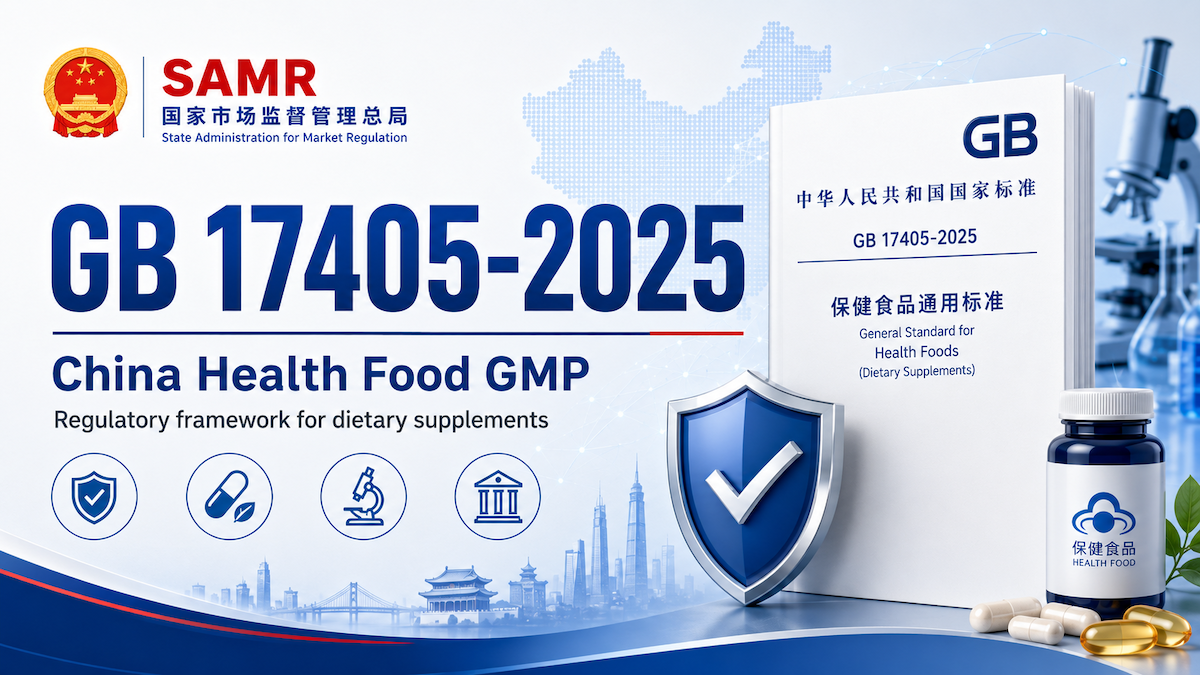
China’s updated Good Manufacturing Practice standard for health foods, GB 17405-2025, will officially take effect on September 2, 2026, replacing the previous version issued in 1998.
The revised standard represents a significant modernization of China’s manufacturing requirements for health foods and introduces stronger expectations covering production environments, cleaning and cross-contamination controls, automation, process validation, supplier management, traceability, and microbiological controls.
Who Is Impacted?
The new standard directly affects manufacturers in China producing regulated health foods, including many companies manufacturing products under China’s health food registration or filing system.
It is particularly important for:
- Chinese health food manufacturers
- OEM and ODM contract manufacturers producing health foods
- International brands using Chinese manufacturers
- Probiotic and fermentation-based product manufacturers
- Botanical extract and functional ingredient suppliers
- Companies supplying ingredients to Chinese health food manufacturers
International ingredient suppliers may also see increased requests from Chinese customers for supplier qualification documents, manufacturing-process information, certificates of analysis, traceability documentation, strain information for microbial ingredients, and other quality-control records.
Key Changes Companies Should Be Aware Of
Environmental controls are strengthened for clean manufacturing areas. The standard establishes requirements for filtered air systems, positive pressure between clean and non-clean areas, air-change rates, temperature and humidity conditions, and routine monitoring of environmental conditions.
Cleaning and changeover procedures must be supported by validation. Manufacturers are expected to demonstrate that cleaning procedures effectively prevent contamination and cross-contamination between products.
For certain liquid products, extraction processes and associated production equipment, manufacturers must establish effective cleaning systems. Clean-in-place, or CIP, systems may be appropriate for major equipment and pipelines, although GB 17405-2025 does not require CIP in every situation if another validated cleaning method can demonstrate equivalent effectiveness.
Automation requirements have also been strengthened. Filling and sealing operations are expected to use automated equipment wherever practical. When automation cannot reasonably be used, manufacturers must validate the process to demonstrate that product quality and safety can still be maintained.
The new standard also places substantially greater emphasis on validation and qualification. Manufacturers must establish validation plans, qualify facilities and equipment, validate critical production processes and operating procedures, maintain validated conditions, and reassess processes when significant changes occur.
Special Requirements for Fermentation and Probiotic Products
Companies producing fermentation-based health foods face additional requirements.
Manufacturers must establish microbiological monitoring programs covering both the production environment and the manufacturing process. Equipment, containers, tools, pipelines and related production systems must be appropriately cleaned and controlled.
Companies maintaining or cultivating microbial strains must also implement controls designed to prevent contamination, strain degeneration or mutation and maintain the genetic stability of production strains.
These requirements may have downstream implications for international probiotic, yeast and fermentation-derived ingredient suppliers whose materials are incorporated into Chinese health food products.
Important Clarification on Information Circulating in the Industry
Some recent industry communications have included highly specific environmental monitoring frequencies and microbiological “alert” and “action” thresholds.
For example, recommendations have circulated suggesting weekly contact-surface monitoring, biweekly air monitoring, monthly drain and wall testing, and alert thresholds set at 60–80% of microbiological limits.
These may represent useful industry practices, but they should not be confused with explicit mandatory requirements contained in GB 17405-2025.
Similarly, the standard requires manufacturers to establish validation planning and periodic revalidation, but it does not specifically require a document formally titled an “annual verification plan” or a “GB 17405 gap analysis.”
Both, however, can be useful compliance-management tools.
What International Brand Owners Should Do Now
Companies using Chinese OEM or ODM manufacturers for regulated health foods should confirm that their manufacturing partners have completed their transition to GB 17405-2025.
HPA-Global recommends asking manufacturers for documentation or confirmation covering:
- Their GB 17405-2025 compliance or gap assessment.
- Current facility and equipment qualification status.
- Cleaning and product-changeover validation.
- Process validation and revalidation procedures.
- Environmental monitoring programs.
- Automation status for filling and sealing operations.
- Microbiological controls for fermentation processes, where applicable.
- Supplier qualification procedures.
- Corrective-action plans for any outstanding compliance issues.
Brand owners should also consider ensuring that manufacturing agreements provide appropriate access to quality records, environmental monitoring data, audit results and corrective-action documentation.
While the manufacturing facility is responsible for complying with the GMP requirements, registration holders and companies commissioning health food production also have responsibilities for supplier oversight and product safety.
Important Distinction for Overseas Companies
GB 17405-2025 should not be interpreted as automatically applying to every dietary supplement company selling products into China.
The standard primarily governs the production of health foods within China’s regulated health food system.
Products manufactured overseas and sold into China through other regulatory pathways, including qualified cross-border e-commerce retail channels, may be subject to different requirements.
Companies should therefore evaluate the regulatory pathway for each product before determining whether GB 17405-2025 applies.
HPA-Global Perspective
GB 17405-2025 is one of the most significant updates to China’s health food manufacturing requirements in decades.
For companies manufacturing health foods in China, the transition will require stronger documentation, validation, environmental controls and manufacturing oversight. For international ingredient suppliers and brand owners, the effects may be seen through more extensive supplier qualification, documentation requests, audits and quality-system expectations from Chinese partners.
HPA-Global will continue monitoring implementation of GB 17405-2025, including regulatory guidance, inspection activity and practical enforcement developments following the September 2 effective date.
Source: State Administration for Market Regulation (SAMR), GB 17405-2025 and HPA-Global regulatory analysis.
If your company is active in the dietary supplement, functional food, ingredient, or health products industry and is not yet a member of HPA-Global, we invite you to consider joining the association. HPA-Global supports members with China and global market intelligence, marketing visibility, industry connections, and access to regulatory support for supplements, ingredients, and related health products in China, the EU, Japan, South Korea, and the U.S. For companies looking to expand internationally and stay ahead of market and regulatory changes, HPA-Global offers one of the best values in the industry. www.hpaglobal.org