China’s Consumer Market Is Getting Tougher — But Supplements Are Bucking the Trend
China has become a significantly more challenging market for many international consumer brands. Slower economic growth, cautious consumer spending, stronger domestic competitors and changing purchasing habits have affected categories ranging from luxury goods and apparel to wine, food and beauty.
Yet one category stands out from this broader slowdown: nutritional supplements and health foods.
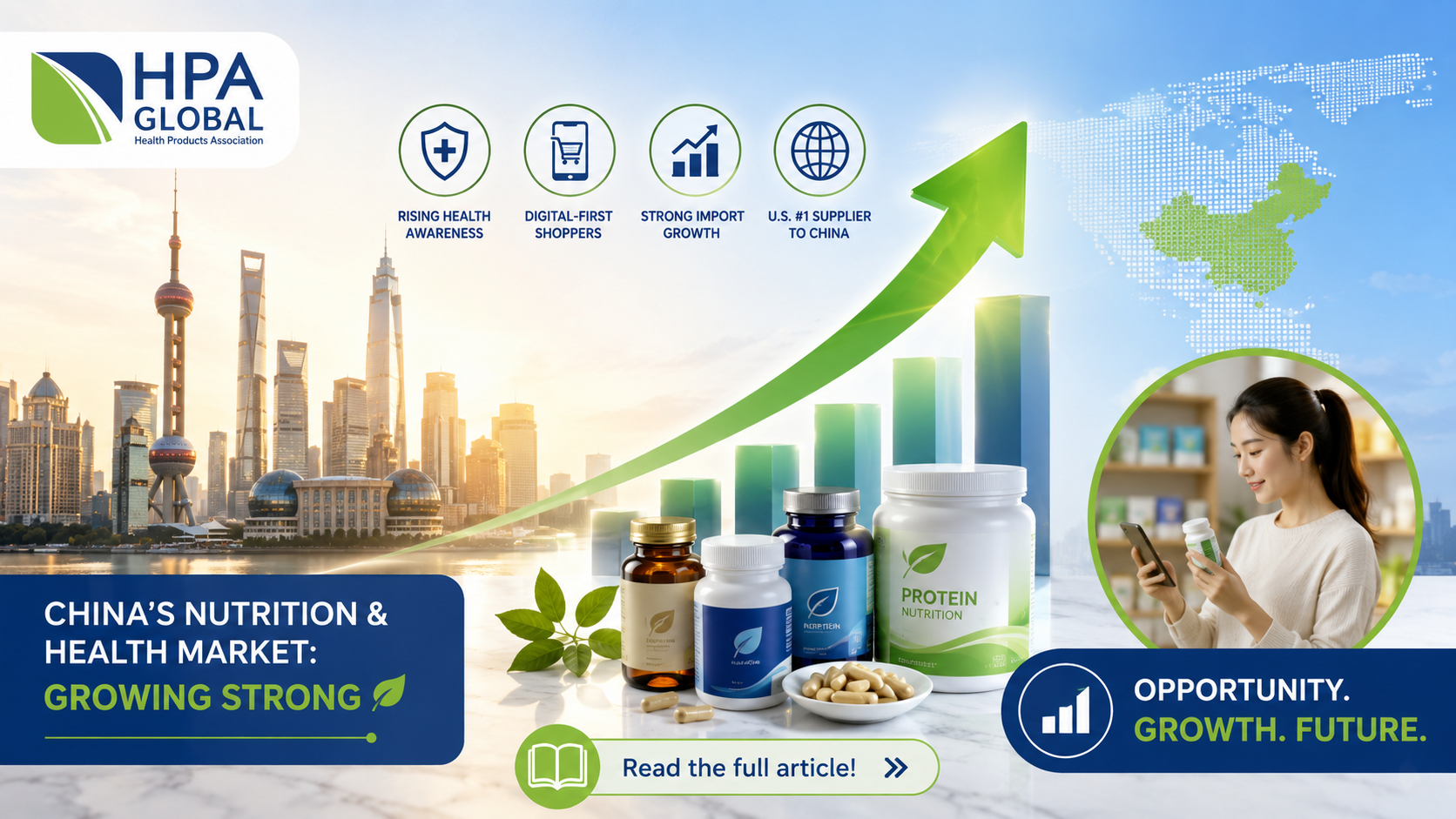
The latest trade and e-commerce data show that Chinese consumers continue to increase their spending on nutrition and health products, including imported products. More importantly for U.S. companies, the United States remains China’s largest foreign supplier of nutritional health products, and U.S. exports to China increased substantially during 2025.
Luxury goods provide one of the clearest examples of China’s changing consumer environment. Bain & Company estimates that China’s mainland personal luxury market declined 17%–19% in 2024 and contracted another 3%–5% in 2025. Consumers have become more selective and increasingly focused on value, while Chinese luxury and premium brands have gained ground in several categories.
Apparel and footwear brands have encountered similar challenges. Nike reported that Greater China revenue declined 13% in fiscal 2025, from approximately $7.55 billion to $6.59 billion. The decline continued in fiscal 2026, when Greater China revenue fell another 11% to approximately $5.85 billion.
Wine has also been particularly difficult. According to the U.S. Department of Agriculture, China’s total wine imports declined 3.2% during January through July 2025 compared with the previous year. U.S. wine exports to China fell much more sharply, declining 70% to just $17.4 million during the period. USDA noted that economic conditions and increasingly value-conscious Chinese consumers were affecting wine consumption.
Food companies have also reported China weakness. General Mills said declines in China and Brazil contributed to a 3% organic sales decline in its International segment during its third quarter of fiscal 2025. The company subsequently announced in June 2026 that it would sell its Häagen-Dazs shop business in mainland China to a Chinese investor group while retaining other Häagen-Dazs retail and foodservice operations in the market.
Beauty has experienced similar pressure. Estée Lauder Companies reported that mainland China sales declined 6% in fiscal 2025, citing a challenging retail environment and subdued consumer sentiment, although its China performance improved during the second half of the year.
Against this backdrop, China’s nutritional supplement and health-food market looks remarkably different.
China imported approximately $8.28 billion worth of nutritional health foods in 2025, an increase of 6.9% from the previous year, according to statistics from the China Chamber of Commerce for Import & Export of Medicines & Health Products (CCCMHPIE).
Even more significant for U.S. companies, the United States remained China’s largest supplier.
China imported approximately $1.65 billion in nutritional health products from the United States in 2025, an increase of 8.6% from 2024. U.S. products represented approximately 19.9% of China’s total health-food imports—nearly one out of every five dollars spent on imported products in the category. Multivitamins and sports nutrition were among the major U.S. product categories.
That performance is notable because it occurred while many other American consumer-product categories were experiencing declining China sales.
Why are supplements different?
One important reason is that health spending increasingly occupies a different place in the Chinese consumer’s budget than discretionary purchases such as luxury goods, fashion or alcohol.
Post-pandemic health awareness has remained elevated, and preventive health management has become more firmly established in everyday consumer behavior. Euromonitor reports that China’s consumer-health market continued growing in 2025 as consumers demonstrated a greater willingness to spend on wellbeing, with supplements increasingly incorporated into regular health routines.
Consumer usage data reinforces this trend. Innova Market Insights reported in 2025 that more than one-quarter of Chinese supplement users had increased their supplement consumption during the previous year, while approximately 80% purchased supplements at least once per month. Vitamins remained the most widely used supplement category, while demand for more personalized and condition-specific products was also growing.
Another important factor is e-commerce.
Nutrition and health products are particularly well suited to China’s digital retail ecosystem because consumers can research ingredients, compare formulations, watch educational content, review scientific claims and purchase products without relying on traditional physical distribution.
CCCMHPIE data indicate that cross-border products represented approximately 46.5% of China’s nutritional health-food e-commerce market in 2025. Sales of cross-border products increased 11.4%, faster than the 8.6% growth reported for domestic products. This suggests that demand for overseas brands and premium functional products remains strong despite the increased competitiveness of Chinese brands.
Separate industry research presented in 2026 estimated that China’s online nutraceutical market reached approximately $17 billion in 2025 and grew 14% year over year. Cross-border e-commerce nutraceutical sales were reported to have grown approximately 20%, illustrating how digital channels continue to provide foreign brands with direct access to Chinese consumers.
There is also an important distinction between selling a foreign lifestyle brand and selling a health product with a clearly identifiable functional benefit.
A consumer considering an expensive handbag, bottle of wine or fashion purchase can easily postpone that expenditure. Supplements addressing healthy aging, cardiovascular health, digestion, bone and joint health, sports performance, sleep or nutritional deficiencies can be viewed much more as part of an ongoing health-management routine.
That dynamic increasingly favors products with clear functionality, scientific substantiation and recognizable ingredients.
It may also help explain why U.S. nutritional products have maintained such a strong position. CCCMHPIE’s analysis of the 2025 import data specifically noted that American products continue to demonstrate strong brand influence and channel penetration within China’s premium nutrition and health market.
However, being an American or international brand by itself is no longer sufficient.
Chinese consumers have become substantially more sophisticated, domestic supplement companies are improving rapidly, and competition across Tmall, JD.com, Douyin, Xiaohongshu and other channels is intense. Foreign brands increasingly need differentiated products, compelling scientific evidence, appropriate China positioning, competitive pricing and a strong digital strategy.
The opportunity therefore remains large, but success requires a different approach than it did a decade ago.
What this means for the dietary supplement industry
China’s broader consumer slowdown should not be interpreted as evidence that the opportunity for international supplement companies is disappearing. The available data points in the opposite direction.
While luxury, apparel, wine, food and other international consumer categories have experienced significant pressure, China’s imports of nutritional health products increased 6.9% in 2025, and imports from the United States grew even faster at 8.6%.
Perhaps most importantly, cross-border health-product sales are also growing faster than domestic products within China’s online market.
The message for international supplement, functional food and ingredient companies is therefore not that China has become an easy market. It has become a more sophisticated and competitive market.
Chinese consumers are increasingly demanding credible science, clearly defined health benefits, quality products, specialized formulations and information that helps them understand why a particular product is worth purchasing. Brands capable of meeting those expectations—and combining them with the right regulatory, e-commerce, marketing and distribution strategy—continue to have substantial opportunities in China.
For the dietary supplement industry, China appears to be one of the areas of consumer spending where health and prevention are proving considerably more resilient than discretionary consumption.
Sources: Bain & Company, 2025 China Personal Luxury Report; NIKE FY2025 and FY2026 financial results; U.S. Department of Agriculture Foreign Agricultural Service, China Wine Market Update 2025; General Mills financial results; The Estée Lauder Companies FY2025 results; China Chamber of Commerce for Import & Export of Medicines & Health Products (CCCMHPIE); Innova Market Insights; Euromonitor International; NutraIngredients; HPA-Global.
If your company is active in the dietary supplement, functional food, ingredient, or health products industry and is not yet a member of HPA-Global, we invite you to consider joining the association. HPA-Global supports members with China and global market intelligence, marketing visibility, industry connections, and access to regulatory support for supplements, ingredients, and related health products in China, the EU, Japan, South Korea, and the U.S. For companies looking to expand internationally and stay ahead of market and regulatory changes, HPA-Global offers one of the best values in the industry. www.hpaglobal.org
Astragalus Polysaccharide Shows Potential in Stroke Research Through the Gut-Brain Axis
Researchers in China have reported new findings suggesting that polysaccharides derived from Astragalus membranaceus, a botanical widely known as Huangqi in traditional Chinese medicine, may help protect against ischemic stroke-related damage by influencing the gut microbiome and the microbiota-gut-brain axis.
The research was conducted by scientists from the China Academy of Chinese Medical Sciences and Beijing University of Chinese Medicine and published in the Chinese Journal of Natural Medicines.
Researchers investigated Astragalus polysaccharide (ASP) in mice using a model of ischemic stroke. Seven days of ASP administration reduced brain infarct size, improved neurological scores and helped preserve neurons. The researchers also observed improvements in markers associated with both the intestinal barrier and blood-brain barrier.
One of the study’s most interesting findings involved the relationship between ASP and the gut microbiome. Stroke can disrupt intestinal microbial populations and increase levels of lipopolysaccharide (LPS), an inflammatory bacterial component that can enter circulation and contribute to systemic and neurological inflammation.
Metagenomic and metabolomic analysis indicated that ASP altered the gut microbiome, increasing several short-chain fatty acid-producing and anti-inflammatory bacterial groups while restoring levels of metabolites including acetate and butyrate. The researchers identified the LPS-TLR4-MAPK signaling pathway as an important mechanism potentially connecting these changes with reduced inflammation and improved intestinal barrier function.
Additional experiments strengthened the proposed connection with the microbiome. When researchers depleted the animals’ gut bacteria using antibiotics, ASP lost its protective effects. When mice were subsequently given gut microbiota from human ischemic stroke patients, ASP again produced beneficial changes in brain injury, intestinal structure and inflammation.
The study also evaluated blood samples from 13 ischemic stroke patients and 17 healthy individuals. LPS levels were significantly higher among the stroke patients, providing some clinical support for further investigation of the gut-brain relationship. However, the therapeutic effects of Astragalus polysaccharide were demonstrated primarily in animal models, and controlled human clinical trials will be necessary before conclusions can be made about its effectiveness for stroke prevention or treatment.
What this means for the dietary supplement industry
The study is noteworthy for the botanical and functional ingredient industries because it connects a well-established traditional Chinese medicinal plant with two rapidly developing areas of health research: the gut microbiome and the gut-brain axis.
Astragalus is already widely used in botanical supplements and traditional Chinese medicine products, but the research focuses specifically on Astragalus polysaccharides rather than simply Astragalus as a general botanical ingredient. This may create additional interest in standardized Astragalus polysaccharide ingredients and research examining their effects on microbiome composition, short-chain fatty acid production, intestinal barrier integrity and inflammatory signaling.
The findings should not, however, be interpreted as evidence that Astragalus supplements can prevent or treat stroke. The primary efficacy research was conducted in mice, and stroke treatment claims would fall well outside the claims normally permitted for dietary supplements in markets such as the United States. Instead, the study provides an interesting direction for future ingredient research and potentially for development of products positioned around areas such as healthy inflammatory response, microbiome health and gut-brain communication where permitted by local regulations.
The research article, “Astragalus polysaccharide ameliorates ischemic stroke via modulating the microbiota-gut-brain axis,” was published August 21, 2026, in the Chinese Journal of Natural Medicines. The EurekAlert news release was published August 31, 2026.
(Source: EurekAlert, Chinese Journal of Natural Medicines & HPA-Global)
Original source: https://www.eurekalert.org/news-releases/1142065
If your company is active in the dietary supplement, functional food, ingredient, or health products industry and is not yet a member of HPA-Global, we invite you to consider joining the association. HPA-Global supports members with China and global market intelligence, marketing visibility, industry connections, and access to regulatory support for supplements, ingredients, and related health products in China, the EU, Japan, South Korea, and the U.S. For companies looking to expand internationally and stay ahead of market and regulatory changes, HPA-Global offers one of the best values in the industry. www.hpaglobal.org